How to Choose Your First Direct-Drive Wheelbase
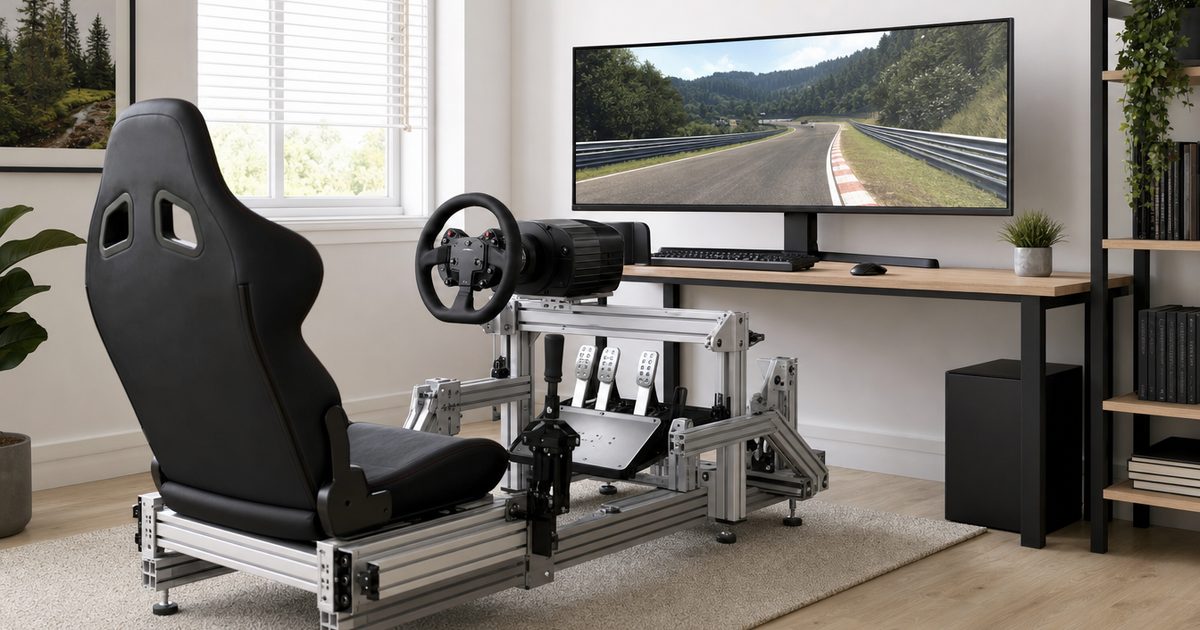
The right first wheelbase makes a corner feel real the moment you turn in — the weight building through the apex, the front tyre loading up, the snap when the rear lets go. The wrong one clips, feels mushy and vague, and ends up in a closet while you wonder why everyone else in the Discord is obsessed with this hobby. The difference is rarely the price. It is knowing a handful of things before you buy: torque, drive type, where load-cell pedals fit, how the base mounts, and the ecosystem trap that costs people twice. This guide walks every decision in the order it actually matters, so you buy the right wheelbase once.
A quick note on how I write here. I'm Marco, the founder of Direct Drive Data. I race iRacing and ACC on my own direct-drive rig out of Austin — a mid-Nm base, load-cell pedals, an aluminium-profile cockpit — and I run a regular weeknight league. My first wheel was a mistake: the cheapest gear-driven set I could find, which clipped constantly, felt mushy, and nearly made me quit within a week. That wasted money is exactly why this site exists. The opinions here come from real time on my own rig and in my league; the product numbers come from manufacturer specs, not from any lab test I'm pretending to have run. I keep those two things separate, always.
The question behind every first buy: how many Nm?
Walk into any sim-racing forum and the most-asked beginner question is some version of "how many Nm do I actually need?" It's the right question, because torque and drive type decide how a wheel feels, and buttons decide almost nothing. Torque, measured in newton-metres (Nm), is the force the base can push back through the rim. It is what turns raw data from the sim — load, grip, kerb strikes, the moment of letting go — into a sensation in your hands. A base that can't push hard enough feels flat and disconnected; you're reading the road off a screen instead of feeling it.
Here's the honest framing most "how many Nm" threads miss: torque is not a "more is always better" number, and it isn't the only number. Past a point, extra Nm just means a base you can't comfortably drive for a two-hour league stint, mounted to a rig that flexes under the load. What you actually want is enough torque to feel detail clearly, matched to your discipline and to a rig that can hold it. For most people building a first rig, an entry-to-mid direct-drive base makes sense because it clears the "feels real" bar without overwhelming a desk, a budget, or your forearms. The Direct-Drive Torque Matcher turns "how many Nm" into a real answer for your setup instead of a guess.
Direct drive vs belt vs gear, in plain English
Before the Nm number matters, the drive type matters more — because it decides how cleanly that force arrives. There are three families you'll run into, and the gap between them is bigger than any spec sheet makes it look.
Gear-driven — the trap that nearly ended my hobby
Gear-driven wheels turn a small motor's output through plastic gears. They're cheap, which is why they fill the entry shelf, but the gears introduce notchiness and the motor is weak enough that the force feedback clips constantly — meaning every strong effect maxes out and flattens into the same dull buzz, so you lose the very detail you're trying to feel. This is the category my first wheel came from, and it's why I almost quit. A gear-driven wheel isn't a smaller version of a good wheel; it's a different, worse experience.
Belt-driven — smoother, but the middle is shrinking
Belt-driven bases route the motor's force through a pulley and belt, which smooths out the gear notchiness and gives a more refined feel. For years this was the sensible mid-tier. But as entry direct-drive prices have dropped, the case for buying new belt-driven has narrowed — you can often get into a real direct-drive base for similar money, with more detail and headroom.
Direct drive — the wheel bolted straight to the motor
Direct drive does exactly what the name says: the wheel mounts straight onto the motor shaft, with no gears or belt in between. The result is force feedback that's strong, fast and detailed, free of notchiness, with the headroom to render small effects without clipping. The Moza R5 is the entry-direct-drive anchor most beginners land on, because it brought genuine direct-drive feel down to a first-base budget. This is the step that changed the hobby for me — the first time a league mate let me drive his direct-drive rig, the car finally felt like it had weight. The sim racing wheelbases hub compares the families and brands in depth.
The Nm tiers, and who each one suits
Once you've settled on direct drive, the Nm band is where discipline comes in. Different racing wants different force, and the rig under the base has to match. Here are the three tiers in plain terms.
- Entry (5–8 Nm). The right band for most first bases, especially on a desk. It's enough torque to feel real road detail and the loss of grip clearly, without fighting the wheel or flexing your setup. Plenty for GT, road and casual oval racing, and a band you won't outgrow quickly. This is where the Moza R5 lives.
- Mid (8–12 Nm). The popular all-round band once you've moved to a cockpit. It adds headroom for stronger effects and finer detail and suits serious GT and road racing, endurance leagues, and drivers who want more feel without going to extremes. This is what I run on my own rig.
- High (18+ Nm). For experienced drivers on a rigid aluminium-profile rig who want maximum detail and the strongest forces — often formula and high-downforce content where loads are genuinely heavy. It needs a stiff cockpit to be usable, and it's more than most first-timers should buy. Big numbers look great on a spec sheet and feel like a workout after an hour if your rig and your discipline don't call for them.
Discipline is the tie-breaker. GT and road racers are well served by entry-to-mid. Formula drivers tend to want the higher bands for the heavier, faster forces of an open-wheeler. Rally and drift reward fast, communicative feedback more than raw strength, so direct drive at a modest Nm shines. Oval is steadier and less demanding on peak torque. Rather than guess, feed your discipline, your rig and your budget into the Direct-Drive Torque Matcher and let it return a band.
Why load-cell pedals matter as much as the base
Here's the thing nobody warned me about, and the single most useful sentence in this guide: you feel pedals before you feel the last few Nm of torque. Braking is where most lap time is won or lost, and braking lives in the pedals — not the wheel. Spend your second chunk of money there before you spend it chasing extra wheelbase torque.
The reason is how the brake measures your foot. A potentiometer pedal measures travel — how far the pedal moves. A load-cell pedal measures pressure — how hard you push. Real brakes respond to pressure, not distance, so a load-cell brake gives you a consistent force reference you can hit lap after lap. You stop locking up because you pushed a millimetre too far; you start braking by feel, the way you would in a real car. For most people building a first rig, a load-cell brake does more for lap time and immersion than another 4 Nm at the wheel ever would. Most load-cell brakes also let you tune the brake force (often rated in kilograms) to your leg strength and seating position, which is what makes them feel natural rather than mushy or impossibly stiff. The sim racing pedals hub walks load-cell vs potentiometer, 2 vs 3 pedal, hydraulic and brake-force tuning in full.
Desk clamp vs cockpit, and the rig that holds the torque
Here's a hard-won truth from years at the wheel: a flimsy desk ruins more first nights than low torque does. A direct-drive base doesn't just spin the wheel — it pushes back, hard, and all of that force goes somewhere. If it goes into a thin desk that flexes and creaks, you feel the desk, not the road, and the wobble drains every bit of detail you paid for.
For an entry-Nm base on a sturdy desk, a desk clamp is genuinely fine — it's how a lot of people start, including me. The catch is desk thickness and rigidity: a thin or wobbly desk flexes under even moderate torque, and clamps can mar or crack a desktop that's too thin. As you move up the Nm tiers, that flex becomes a real problem, and the base will outrun the desk. That's when a wheel stand (compact, holds wheel and pedals) or a cockpit (a seat plus a rigid frame) earns its place. The stiffest option is an aluminium-profile chassis built from modular extrusion — it stays planted under heavy force, which is why high-Nm rigs all end up there. Rigidity should scale with your torque. The Direct-Drive Torque Matcher flags when your mount can't safely hold the Nm you want and points you to a stand or rig instead; once you know the cockpit's the move, the Rig-Fit Calculator sizes the right cockpit type to your height, seating style and room. The sim racing cockpits hub covers stands, foldable cockpits and profile chassis in depth.
The ecosystem lock-in trap
This is the second thing nobody warned me about, and the one that quietly costs people the most. Wheelbases, rims and sometimes pedals are tied to a brand ecosystem — the big four are Fanatec, Moza, Logitech and Thrustmaster — and parts rarely cross cleanly between them. The wheelbase and the rim talk to each other through a quick-release (QR) that is usually proprietary, so a rim built for one brand often won't mount another brand's base without an adapter, if at all. Pick a base and you've largely chosen the family of rims, and sometimes pedals, you'll buy for years.
That's not a reason to panic — every major ecosystem makes good gear. It's a reason to choose the ecosystem deliberately, before you buy the base, by looking at the rims you'll eventually want, whether the pedals are cross-compatible, and how the brand's quick-release and upgrade path look. The mistake is backing into an ecosystem because one base was on sale, then discovering the rim you actually want lives in a different family and you're paying twice — once to leave, once to re-buy. I've watched league mates do it, and I came close myself. The sim racing wheels hub explains which rim mounts which base and how QR compatibility really works.
Budget tiers: what your money buys
You don't need to spend a fortune, but there's a floor below which you're buying frustration. Here are the honest tiers for a first rig.
- Under $300 — the danger zone. This is where the cheap gear-driven wheels live: notchy, clipping, mushy. It's exactly where my first-wheel mistake came from. A wheel here doesn't get you started cheaply; it gets you started badly, and the money is wasted twice when you replace it. Skip it.
- ~$500–$700 — the entry direct-drive sweet spot. An entry direct-drive base (the Moza R5 sits here) plus a basic GT rim. This is where a genuinely good first wheelbase starts, and where most people should begin. Add the pedals and cockpit later.
- ~$700–$1,200 — the full beginner cart-stack. Entry-to-mid base, a GT rim, a load-cell pedal set, and a sturdy stand or foldable cockpit. This is a complete rig that feels real and won't need replacing as you improve — the smart target if you can stretch to it.
- $1,500+ — mid-to-high Nm and a profile rig. A mid-or-high-Nm base, nicer rim, premium load-cell or hydraulic pedals, and an aluminium-profile cockpit. Worth it once you know your discipline and that you'll stick with the hobby. Overkill for a first night.
The full beginner cart, in buying order
A wheelbase is the first purchase, not the only one. Buy in this order and you won't over-spend on the wrong thing first — this is the natural sim-rig cart-stack.
- The wheelbase — chosen on drive type, Nm band and ecosystem, as above. This is the heart of the rig; get it right first. See the best sim racing wheelbase guide.
- The rim — GT for the widest range of cars to start, then formula or rally later. It has to match your base's quick-release. See the best sim racing wheels & rims.
- Load-cell pedals — the upgrade that fixes braking first. Prioritise these over extra wheelbase torque. See the best sim racing pedals.
- A cockpit or stand — rigid enough to hold the torque, so the force goes into road feel, not into flexing the frame. See the best sim racing cockpit.
- A shifter or handbrake — last. Add an H-pattern or sequential shifter, or a handbrake for rally and drift, once the core rig is solid.
The rookie mistakes to skip
Almost all first-rig regret comes from the same short list. Avoid these and you're ahead of where I was for my first frustrating week.
- Buying a cheap gear-driven wheel to "start small." The clipping-and-mushy trap. It doesn't ease you in; it pushes you out. Start with entry direct drive instead.
- Chasing the biggest Nm number. Big torque on a flimsy rig, in a discipline that doesn't need it, is a workout, not an upgrade. Match the band to your discipline and your frame.
- Skipping load-cell pedals. Pouring everything into the base and running cheap travel pedals leaves lap time and immersion on the table. You feel pedals first.
- Bolting a strong base to a thin desk. Flex eats the detail you paid for. Match rigidity to torque — the Torque Matcher flags when your mount can't hold the Nm you want.
- Backing into an ecosystem by accident. Choose Fanatec, Moza, Logitech or Thrustmaster on purpose, by the rims and pedals you'll want — not by which base was on sale.
Frequently asked questions
What is the best sim racing wheelbase for a beginner?
For most beginners, an entry direct-drive base in the 5–8 Nm range hits the sweet spot — enough torque to feel real force feedback without overwhelming a desk or a tight budget. The Moza R5 is the bang-for-buck anchor many first-timers land on. Verified picks land on the best-wheelbase guide once real data is in.
Why does torque (Nm) matter more than buttons?
Torque is the force the base can push back through the wheel — it is what makes the road, the grip and the loss of grip feel real. Buttons and a fancy rim are convenience; torque and drive type are the experience. A direct-drive base with modest Nm beats a button-laden gear-driven wheel every time.
What is the difference between direct drive, belt and gear?
Gear-driven wheels use plastic gears — cheap, but notchy and prone to force-feedback clipping. Belt-driven smooths that out with a pulley. Direct drive bolts the wheel straight to the motor, so the force feedback is detailed, strong and free of the gear notchiness. Direct drive is the upgrade beginners feel immediately.
How much torque (Nm) do I actually need?
Entry direct-drive (5–8 Nm) suits most newcomers and tight desks. Mid (8–12 Nm) is the popular all-round band for GT and road racing on a cockpit. High (18+ Nm) is for experienced drivers on a rigid rig who want maximum detail. Run the Torque Matcher to match a band to your discipline and setup.
Are load-cell pedals more important than the wheelbase?
Load-cell pedals are the upgrade most sim racers feel first after the base. A load-cell brake measures pressure, not travel, so braking becomes consistent and repeatable lap after lap. Many racers would put load-cell pedals ahead of extra wheelbase torque — you feel the pedals before you feel the last few Nm.
What is ecosystem lock-in and why does it matter?
Wheelbases, rims and sometimes pedals are tied to a brand ecosystem — Fanatec, Moza, Logitech or Thrustmaster — and parts often do not cross between them. Pick a base and you are largely committed to that brand’s rims and quick-release. Choosing the ecosystem before you buy is how you avoid paying twice.
Do I need a cockpit, or will a desk clamp work?
A desk clamp is fine for entry torque on a sturdy desk. But higher-Nm bases generate enough force to flex or damage a thin desk, and the wobble ruins the feel. The Direct-Drive Torque Matcher flags when your mount can't safely hold the torque you want and points you to a stand or rig; the Rig-Fit Calculator then sizes the right cockpit type to your height and room.
How much should I spend on my first sim racing rig?
A genuinely good entry direct-drive base, a GT rim, a load-cell pedal set and a sturdy stand land roughly in the $700–$1,200 range as a first cart-stack. You can start with just the base and a basic rim under $500 and add pedals and a cockpit later. The mistake is a cheap gear-driven wheel — that money is wasted twice.
Where to go next
The four silos, each starting from a buyer-first hub.