Best Sim Racing Cockpits
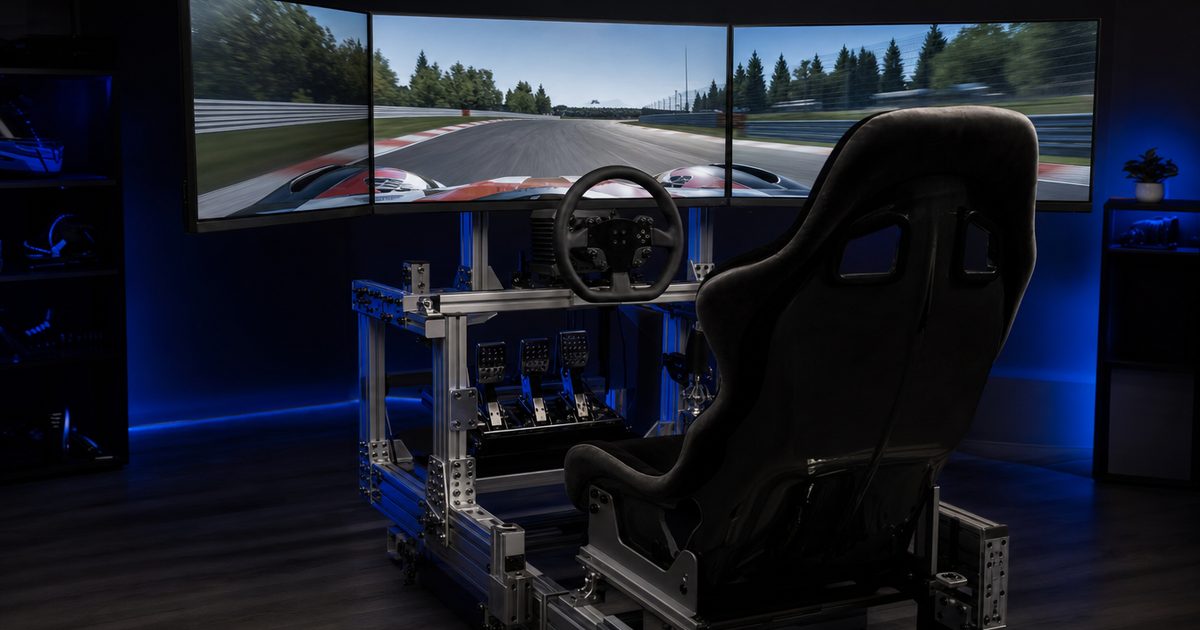
The best cockpit is the one rigid enough to hold your torque without flexing, in a footprint you can actually live with. Flex ruins more force feedback than low torque does, so the frame matters more than people expect. This guide explains the specs that decide the rig — type, profile size, wheel-deck range, occupant height, foldability and weight — then matches them to five categories: best overall, best budget wheel stand, best foldable cockpit, best aluminium-profile chassis and best compact / small-space. Verified picks appear in each slot once real product data is in.
A note on how to read this. There is no single "best" cockpit for everyone — the right one depends on your wheelbase torque, the space you have, and whether the rig has to fold away between sessions. So the value here is the framework: what each spec changes, so you can shortlist a frame that matches both your base and your room. Read the framework first, then look at the picks. The one thing worth saying plainly, from years on my own aluminium-profile rig: a flimsy desk or a flexing stand ruins more first nights than low torque does. The frame is not the glamorous part of a rig, but it is the part that lets every other part actually work.
Specs verified against manufacturer details and current Amazon listings — no hands-on testing claims. Type, profile size, wheel-deck range, occupant height and weight are drawn from published manufacturer specs.
How to choose a sim racing cockpit
A handful of specs decide whether a rig suits you — and rigidity should track your torque.
Type and rigidity — match it to your torque
Type is the first decision because it sets the ceiling on rigidity, and rigidity is what a rig is for. A wheel stand holds the wheel and pedals in the smallest, cheapest package — fine for entry torque, but it twists under heavy force. A foldable cockpit adds a seat and more stiffness, then folds away between sessions, which makes it the space-saving middle ground. An aluminium-profile chassis is the stiffest and most adjustable of all, the frame that stays planted under the highest Nm bases.
The single rule that ties this together: match the type to your wheelbase torque. Spec-by-spec, an entry base is happy on a stand, a mid base wants a stiff frame, and a high-Nm base needs a profile chassis so the force becomes road feel instead of frame flex. Buying more rig than your base needs wastes money and space; buying less hides the torque you paid for. The cockpits hub walks the trade-offs in more depth.
Profile size and wheel-deck range
Profile size — the gauge of the aluminium extrusion — is the spec that quantifies rigidity. A larger profile resists twist better, which is exactly what a high-Nm base needs, while a smaller profile is lighter and cheaper but flexes sooner under heavy force. Spec-by-spec, this is the figure that separates a chassis that stays planted from one that shimmies when the base loads up, so it is worth reading rather than glossing over.
The wheel-deck range sets how far the wheel adjusts toward or away from you, which decides whether the rig fits your driving position — GT-upright or formula-reclined. Together, profile size and wheel-deck range determine both how rigid the frame is and whether you can actually get comfortable in it. A stiff chassis you cannot position to suit you is no better than a flexing one you can, so read both figures, not just the headline rigidity claim.
Occupant height, foldability and weight
A few fit-and-practicality specs round out the choice. The occupant-height range tells you whether the seat genuinely adjusts to your build — a rig sized for someone much taller or shorter will never be comfortable, no matter how rigid it is. Foldability matters if the rig shares a room or has to clear out between sessions: a foldable cockpit folds down, a profile chassis does not.
Weight is the spec that cuts both ways. Heavier usually means more rigid, which is the whole point under a strong base — mass is part of what keeps a rig planted. But weight also makes a rig harder to move, so if your space is shared or you race in a room you also live in, a lighter foldable design may matter more than the last bit of stiffness. Run the Rig-Fit Calculator to check the occupant-height range and footprint against yourself and your space before you commit.
The cockpits compared
A short list of widely available cockpits and wheel stands, compared on the specs above. Specs are verified against manufacturer details and current Amazon listings — no hands-on testing claims.
| Best for | Type | Profile size | Wheel-deck range | Foldable | Weight |
|---|---|---|---|---|---|
| Best overall | Formula/GT cockpit (no seat) | Steel tube frame | Fully adjustable | Yes | 44.1 lbs |
| Best budget wheel stand | Wheel stand (no seat) | Steel | Adjustable tilt | Yes | 12 kg |
| Best foldable cockpit | Full cockpit with seat | Steel frame | Adjustable | Yes | Not listed |
| Best aluminium-profile chassis | |||||
| Best compact / small-space | Compact wheel stand | Steel | Adjustable | Yes | Not listed |
Our top picks
Best overall: Next Level Racing F-GT LITE Simulator Cockpit – Grey Edition (NLR-S015GR)

Best overall
Next Level Racing F-GT LITE Simulator Cockpit – Grey Edition (NLR-S015GR)
Next Level Racing
- Type: Formula/GT cockpit (no seat)
- Profile size: Steel tube frame
- Wheel-deck range: Fully adjustable
- Occupant height: Up to ~6'5"
- Foldable: Yes
- Weight: 44.1 lbs
A formula-and-GT dual-position foldable cockpit from Next Level Racing that accommodates most wheelbases and pedal sets without a bundled seat.
Last checked 2026-06-14
Best budget wheel stand: GT OMEGA PRO Wheel Stand - Compatible with Logitech G29, G920, & G923, Thrustmaster T300, T500 TX, & TH8A, and Fanatec, Foldable Sim Racing Wheel Stand

Best budget wheel stand
GT OMEGA PRO Wheel Stand - Compatible with Logitech G29, G920, & G923, Thrustmaster T300, T500 TX, & TH8A, and Fanatec, Foldable Sim Racing Wheel Stand
GT OMEGA
- Type: Wheel stand (no seat)
- Profile size: Steel
- Wheel-deck range: Adjustable tilt
- Occupant height: Universal (chair-based)
- Foldable: Yes
- Weight: 12 kg
GT Omega's PRO wheel stand folds flat for storage and supports Logitech, Thrustmaster, and Fanatec wheelbases with adjustable tilt.
Last checked 2026-06-14
Best foldable cockpit: RACGTING Racing Simulator Cockpit for G920 G29 G923, Foldable Racing Simulator for Thrustmaster T248X T248 T300 T150 458 TX Xbox PS5 PS4 PC (Black)

Best foldable cockpit
RACGTING Racing Simulator Cockpit for G920 G29 G923, Foldable Racing Simulator for Thrustmaster T248X T248 T300 T150 458 TX Xbox PS5 PS4 PC (Black)
RACGTING
- Type: Full cockpit with seat
- Profile size: Steel frame
- Wheel-deck range: Adjustable
- Occupant height: Universal
- Foldable: Yes
- Weight: Not listed
An affordable foldable full-cockpit with integrated seat that supports Logitech, Thrustmaster, and similar wheelbases, collapsing for compact storage.
Last checked 2026-06-14
Best aluminium-profile chassis:
Best aluminium-profile chassis
- Type:
- Profile size:
- Wheel-deck range:
- Occupant height:
- Foldable:
- Weight:
Last checked 2026-06-14
Best compact / small-space: ARES WING Sim Racing Wheel Stand, Racing Simulator Cockpit with Chair Fixing Slot, Foldable Sim Racing Cockpit Compatible with Logitech G29 G920 G923, Fanatec, Thrustmaster, Moza, Gaming Equipment

Best compact / small-space
ARES WING Sim Racing Wheel Stand, Racing Simulator Cockpit with Chair Fixing Slot, Foldable Sim Racing Cockpit Compatible with Logitech G29 G920 G923, Fanatec, Thrustmaster, Moza, Gaming Equipment
ARES WING
- Type: Compact wheel stand
- Profile size: Steel
- Wheel-deck range: Adjustable
- Occupant height: Universal (chair-based)
- Foldable: Yes
- Weight: Not listed
A compact, budget-friendly foldable wheel stand that pairs with any existing chair and supports Logitech, Fanatec, Thrustmaster, and Moza wheelbases.
Last checked 2026-06-14
The mistakes that cost rig buyers the feel they paid for
The most common rig mistake is buying the base and pedals first, then bolting them to whatever stand is cheapest — and wondering why a strong base feels vague. A high-Nm wheelbase on a flexing stand puts its force into twisting the frame instead of into your hands, so the torque you paid for simply disappears into wobble. Spec-by-spec, rigidity is the multiplier on everything upstream: a stiff brake and a strong base only deliver what their figures promise if the frame holds still.
The second mistake is forgetting the accessories you will add later. A wheel stand has few mounting points, so the shifter or handbrake you buy in six months may have nowhere solid to go, while a profile chassis lets you clamp a bracket almost anywhere along the extrusion. The fix is to choose the rig for the base you intend to end up with and the accessories you plan to add — not just the base you own today. That is how a frame stays the part of the rig you never have to buy twice.
Who should buy what
The mid-to-high-Nm racer — an aluminium-profile chassis
If you run a mid or high-Nm base, the best overall and best aluminium-profile chassis slots point the same way: a profile rig. Spec-by-spec, an aluminium-profile chassis is the stiffest and most adjustable frame on the page, which is exactly what a strong base needs — the larger the profile, the better it resists the twist that turns torque into wasted shudder. On a profile rig, the force you paid for becomes road feel instead of frame flex.
The trade-off is footprint and price: a profile chassis is a permanent fixture that does not fold away, and it costs more than a stand. For a racer with the space and a base worth feeding, that is the right spend, because it is the frame that finally lets a strong base and a stiff brake work the way their specs promise. It is the rig most serious league racers settle on and stop upgrading.
The entry-torque or tight-budget buyer — a wheel stand
The best budget wheel stand slot is about spending only on the rigidity your base actually needs. For an entry-Nm base, a sturdy wheel stand holds the wheel and pedals solidly enough that the feedback comes through clean, at a fraction of the cost and space of a full cockpit. Spec-by-spec, the figures that matter here are build sturdiness and a stable footprint, not seat adjustability you will not use.
What you give up is headroom: a wheel stand flexes under high torque, so it caps how strong a base you can drive cleanly. For a beginner on an entry base that is no loss — the stand matches the torque you have. The honest caution is not to pair a flimsy stand with a strong base later, because a high-Nm unit on a twisting stand is the upgrade mistake racers regret most.
The shared or tight space — a foldable cockpit
The best foldable cockpit slot suits the racer whose rig shares a room or has to clear out between sessions. Spec-by-spec, a foldable cockpit adds a seat and noticeably more rigidity than a bare wheel stand, then folds down when you are done — bridging the gap between a stand and a fixed profile chassis without claiming a permanent corner of the room.
The trade-off is stiffness: a foldable design is not as rigid as a full aluminium-profile rig, so it suits entry-to-mid torque rather than the highest Nm bases. For a buyer whose main constraint is space rather than maximum feel, that is the sensible middle choice — most of the comfort and rigidity of a cockpit, with the practicality of folding it away.
The smallest spaces — a compact rig
The best compact / small-space slot is for the racer working with the tightest footprint of all — a small room, a desk corner, a setup that cannot grow. Spec-by-spec, the figures that matter here are the rig's overall footprint and, where it folds or stows, how small it packs down, balanced against keeping enough rigidity to drive an entry base cleanly.
The trade-off is the obvious one: a compact rig prioritises space over the stiffness and seat adjustment of a larger chassis, so it suits modest torque and modest ambitions rather than a high-Nm build. For a racer whose space is the hard limit, it is the rig that actually fits — and a rig you can set up is worth more than a stiffer one you have nowhere to put. The Rig-Fit Calculator confirms it fits your room before you buy.
What to buy alongside the cockpit
A cockpit is bought to match the rig it carries, so settle the wheelbase and pedals first, then choose a frame rigid enough to hold them. A rim that fits your base completes the core rig. Will it all fit? Run the Rig-Fit Calculator.
Frequently asked questions
What is the best sim racing cockpit overall?
For most racers, an aluminium-profile cockpit is the best all-round choice — it stays rigid under mid-to-high wheelbase torque and adjusts to fit. A foldable cockpit suits tight or shared spaces, and a wheel stand suits entry torque and the smallest budgets. The spec that decides which you need is your wheelbase torque: rigidity should scale with the Nm you are driving. Verified picks land on this page once real product data is in.
Do I need a cockpit, or will a wheel stand do?
For entry-Nm bases and limited space, a sturdy wheel stand is fine and saves both money and floor space. As torque rises, flex ruins the feel — a high-Nm base on a flimsy stand twists, and the force you paid for goes into shaking the frame instead of into road feel. An aluminium-profile cockpit stays planted under heavy force, which is why serious rigs move to profile chassis as torque climbs. Match the rig to the base, not the other way round.
How rigid does my rig need to be?
Rigidity should scale with your wheelbase torque. Entry torque (5–8 Nm) is happy on a sturdy stand; mid torque (8–12 Nm) wants a stiff frame; high torque (18+ Nm) needs a proper aluminium-profile cockpit so the force goes into road feel, not into flexing the frame. Spec-by-spec, a flimsy rig under a strong base is the upgrade mistake people regret most — the torque is there, but the flex hides it.
Where do shifters and handbrakes mount on a cockpit?
They bolt to the side or front of the cockpit, usually onto aluminium profile or a dedicated mount bracket. A wheel stand has limited mounting points; a profile chassis has many, because you can clamp a bracket almost anywhere along the extrusion. If you plan to add a shifter or handbrake later, check the rig has somewhere solid to put them before buying — it is the accessory question people forget until they are holding a shifter with nowhere to bolt it.
Will a sim racing cockpit fit me and my space?
Two specs decide this: the occupant-height range, which tells you whether the seat actually adjusts to your build, and the rig footprint, which tells you whether it fits your room. Aluminium-profile chassis adjust the most but take the most space; foldable cockpits fold down between sessions; wheel stands are the smallest of all. Check the height range and footprint against yourself and your room — the Rig-Fit Calculator does this from your height, seating style and space in one step.
Is a foldable cockpit a good compromise?
For shared rooms and tight spaces, yes. A foldable cockpit adds a seat and more rigidity than a bare wheel stand, then folds away when you are not racing, so it bridges the gap between a stand and a fixed profile chassis. The trade-off is that it is not as stiff as a full aluminium-profile rig, so it suits entry-to-mid torque rather than the highest Nm bases. If space is your main constraint, it is often the sensible middle choice.