Best Sim Racing Pedals
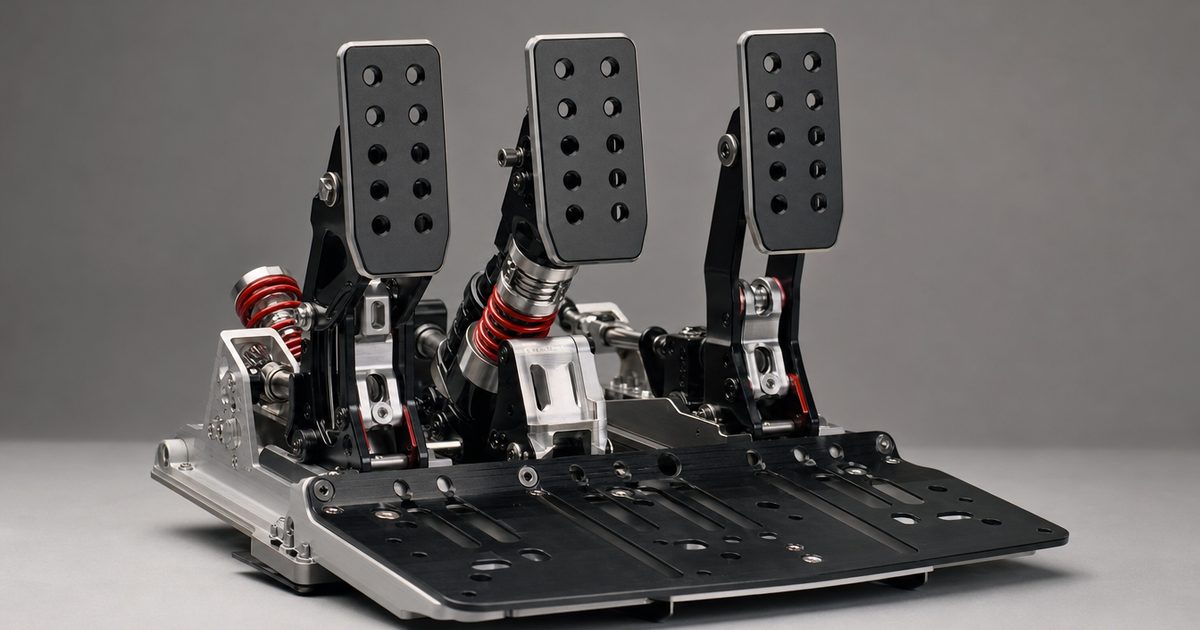
The best pedals are the ones that let you brake the same way every single lap — and that means a load-cell brake. Braking is where most lap time is won, so this is the upgrade that pays off before a stronger wheelbase ever does. This guide explains the specs that decide the set — pedal count, load cell, travel, adjustability, material and mount — then matches them to five categories: best overall, best budget load-cell, best 2-pedal set, best 3-pedal set and best hydraulic. Verified picks appear in each slot once real product data is in.
A note on how to read this. There is no single "best" pedal set for everyone — the right one depends on whether you drive manual cars, how rigid your rig is, and how much you care about the last few percent of brake feel. So the value here is the framework: what each spec changes, so you can shortlist a set that fits your driving and your frame. Read the framework first, then look at the picks. The one thing worth saying up front, from a lot of league nights: you feel pedals before you feel the last few Nm of a wheelbase. Most people in my league moved to a load-cell brake within a season of going direct drive, because braking is where the lap time hides — which is exactly why this guide is load-cell-first.
Specs verified against manufacturer details and current Amazon listings — no hands-on testing claims. Pedal count, load-cell force (kg), travel, adjustability and mounting are drawn from published manufacturer specs.
How to choose sim racing pedals
A handful of specs decide whether a pedal set suits you — and the brake matters most.
Load cell — the spec that fixes braking
A load-cell brake measures how hard you press, not how far the pedal moves — and that single difference is the most important spec on the page. A real brake responds to pressure: push twice as hard and you get twice the braking, regardless of exactly where the pedal sits. A load cell reproduces that, so braking becomes consistent and repeatable lap after lap. A potentiometer brake, by contrast, reads travel, so you have to land the pedal in precisely the same position every time to get the same braking — far harder under pressure, and the source of the inconsistent stops that cost lap time.
Spec-by-spec, this is why a load-cell brake is worth prioritising over more wheelbase torque: braking is where most lap time is found, and a load-cell brake fixes braking consistency directly, while extra Nm mostly sharpens feel you may already have enough of. If you upgrade one thing after going direct drive, the figures say make it the brake.
Pedal count and adjustability
Pedal count is a function of the cars you drive. Two pedals — throttle and brake — cover modern paddle-shift GT and formula racing completely. A third pedal adds a clutch for manual H-pattern cars, sharper race starts, and some rally and classic content. Spec-by-spec, the third pedal adds nothing if you never drive manual cars, so the honest question is whether your content actually uses a clutch before you pay for one.
Adjustability is the spec that turns a good pedal set into one that fits you. Pedal angle, spacing, brake stiffness and travel let you set the pedals to your legs and seating position, which is what makes a stiff brake feel natural rather than awkward. The more of these a set lets you tune, the better you can dial it to your leg strength — the pedals hub walks the full load-cell-versus-potentiometer case if you want the deeper comparison.
Material, travel and mount
Build material and travel set how solid and precise the pedals feel underfoot. A heavier metal pedal set with short, firm travel feels closer to a real car than a light plastic set with long, springy travel — the figures here are about precision and durability, the things you feel every lap without thinking about them.
The mount, though, is the spec people overlook and regret. A stiff load-cell or hydraulic brake pushes back hard, and it pushes against whatever it is bolted to — so on a flexing frame the force bends the mount instead of loading the brake, and the feel goes soft. That is where a proper cockpit or solid stand earns its keep: it gives a strong brake something rigid to push against, so the force you apply turns into braking rather than frame flex. Pedals and the rig that holds them are really one decision.
The pedals compared
A short list of widely available sim racing pedal sets, compared on the specs above. Specs are verified against manufacturer details and current Amazon listings — no hands-on testing claims.
| Best for | Pedal count | Load cell | Travel | Adjustability | Mount |
|---|---|---|---|---|---|
| Best overall | 2 (throttle + brake) | Yes | Adjustable | Full (arms, angle, spacing) | Floor / rig mount, USB-C |
| Best budget load-cell | 2 | Yes (Hall Effect + hydraulic) | Adjustable | Angle and spacing | Floor / rig, USB-C |
| Best 2-pedal set | 2 | Yes | Adjustable | Angle, spacing, height | Floor / rig, USB |
| Best 3-pedal set | 3 (throttle, brake, clutch) | No (magnetic sensors) | Adjustable | Pedal spacing | Floor / T-series wheelbase |
| Best hydraulic | 3 | Yes (load cell + hydraulic) | Adjustable | Full (angle, spacing) | Floor / rig, USB-C |
Our top picks
Best overall: ASETEK SimSports La Prima™ Load Cell Sim Racing Pedals | Adjustable and Customizable Sim Pedals Arms | Built to Replicate Real-Life Racing sim | PC Compatible

Best overall
ASETEK SimSports La Prima™ Load Cell Sim Racing Pedals | Adjustable and Customizable Sim Pedals Arms | Built to Replicate Real-Life Racing sim | PC Compatible
ASETEK
- Pedal count: 2 (throttle + brake)
- Load cell: Yes
- Travel: Adjustable
- Adjustability: Full (arms, angle, spacing)
- Material: Aluminum
- Mount: Floor / rig mount, USB-C
ASETEK's La Prima delivers genuine load cell braking in a fully adjustable two-pedal set designed for serious sim racers on PC.
Last checked 2026-06-14
Best budget load-cell: SIMSONN Plus X Sim Racing Pedals PC Racing Simulator Load Cell HE Hydraulic Pedal Support Haptic Reactor-Silver (2 Pedals Set P2-H2)

Best budget load-cell
SIMSONN Plus X Sim Racing Pedals PC Racing Simulator Load Cell HE Hydraulic Pedal Support Haptic Reactor-Silver (2 Pedals Set P2-H2)
SIMSONN
- Pedal count: 2
- Load cell: Yes (Hall Effect + hydraulic)
- Travel: Adjustable
- Adjustability: Angle and spacing
- Material: Aluminum
- Mount: Floor / rig, USB-C
SIMSONN's entry-level Plus X 2-pedal set combines load cell and hydraulic feel for sim racers who want force-feedback braking on a budget.
Last checked 2026-06-14
Best 2-pedal set: MOZA SRP2 Dual Pedals Set of Load Cell Brake and Throttle Fully Adjustable Pedal Angle Spacing and Height for PC Racing Game

Best 2-pedal set
MOZA SRP2 Dual Pedals Set of Load Cell Brake and Throttle Fully Adjustable Pedal Angle Spacing and Height for PC Racing Game
MOZA
- Pedal count: 2
- Load cell: Yes
- Travel: Adjustable
- Adjustability: Angle, spacing, height
- Material: Aluminum
- Mount: Floor / rig, USB
MOZA's SRP2 dual-pedal set uses load cell braking and is fully adjustable for angle, spacing, and height, integrating natively with MOZA wheelbases.
Last checked 2026-06-14
Best 3-pedal set: Thrustmaster T-3PM Pedals (compatible w/ PS5, PS5 Pro, PS4, XBOX Series X/S, One, PC)

Best 3-pedal set
Thrustmaster T-3PM Pedals (compatible w/ PS5, PS5 Pro, PS4, XBOX Series X/S, One, PC)
Thrustmaster
- Pedal count: 3 (throttle, brake, clutch)
- Load cell: No (magnetic sensors)
- Travel: Adjustable
- Adjustability: Pedal spacing
- Material: Metal and plastic
- Mount: Floor / T-series wheelbase
Thrustmaster's T-3PM delivers a three-pedal clutch/brake/throttle set compatible with PS5, Xbox, and PC, offering a stepping-stone from basic two-pedal setups.
Last checked 2026-06-14
Best hydraulic: SIMSONN PRO X Ultra Sim Racing Pedals PC Racing Simulator Load Cell HE Hydraulic Pedals Support Haptic Reactor (PRO X Ultra P3-H3)

Best hydraulic
SIMSONN PRO X Ultra Sim Racing Pedals PC Racing Simulator Load Cell HE Hydraulic Pedals Support Haptic Reactor (PRO X Ultra P3-H3)
SIMSONN
- Pedal count: 3
- Load cell: Yes (load cell + hydraulic)
- Travel: Adjustable
- Adjustability: Full (angle, spacing)
- Material: Aluminum
- Mount: Floor / rig, USB-C
SIMSONN's PRO X Ultra combines load cell sensing with hydraulic resistance across three pedals, supporting haptic reactor integration for immersive force feedback.
Last checked 2026-06-14
Who should buy what
The racer making one upgrade after the wheelbase — a load-cell brake
If you have just gone direct drive and can upgrade one more thing, the best overall slot is the answer: a load-cell pedal set. Spec-by-spec, the load-cell brake fixes braking consistency directly, and braking is where most lap time hides — so it is the upgrade most racers feel before they would ever feel the last few Nm of a stronger base. It carries across every car and every sim, which is what makes it the highest-value single purchase in the cart-stack after the base itself.
The trade-off is that a good load-cell set asks for a rigid mount and costs more than a basic potentiometer set. Both are worth it: the mount is a one-time rig decision, and the brake is the part you load on every corner of every lap. This is the slot most league racers settle on and the one fewest of them regret.
The tight budget — a load-cell brake first, features second
The best budget load-cell slot is about getting the one spec that matters — the load-cell brake — onto your rig without paying for the rest. A budget load-cell set skips the heaviest construction, the deepest adjustability and the clutch, and puts the pressure-based brake where your money does the most good. Spec-by-spec, a budget load-cell brake still measures force the right way, which is the whole point.
What you give up is range and refinement: less brake-force headroom to tune, simpler construction, often no clutch. For a racer on a budget that is the right compromise, because the cheapest load-cell brake still fixes braking consistency in a way no potentiometer set at the same price can. You can add adjustability later; the measuring principle you cannot upgrade after the fact.
The paddle-shift GT and formula driver — a 2-pedal set
The best 2-pedal set slot suits the racer whose content is paddle-shift — modern GT and formula, where there is no clutch to use. Spec-by-spec, two pedals cover everything these cars ask for, and skipping the clutch lets the budget go into a better brake instead of a pedal you would never press. It is the efficient choice for a focused discipline.
The trade-off is simple: the day you want a manual H-pattern car, a 2-pedal set cannot give you a clutch. If you are confident your racing stays paddle-shift, that is no loss at all. If you think manual cars or sharper race starts are in your future, the next slot is the safer buy.
The manual and all-content driver — a 3-pedal set
The best 3-pedal set slot is for the racer who wants every kind of car: manual H-pattern classics, rally, sharper race starts, alongside the paddle-shift content. Spec-by-spec, the third pedal adds the clutch that those cars and starts use, so a 3-pedal load-cell set is the most versatile choice on the page — it leaves nothing on the table.
The trade-off is cost and a pedal you will not use if you only ever drive paddle-shift cars. For a driver whose content is broad, that is a small price for never being locked out of a car type. This is the all-rounder set, and the one to buy if you are not sure which way your racing will go.
The committed racer chasing brake feel — hydraulic pedals
The best hydraulic slot suits the experienced racer chasing the last bit of brake feel. Spec-by-spec, hydraulic pedals use a fluid damper to give a firm, progressive pressure build that some drivers prefer to a pure load-cell stack, with deep adjustability at the top end. They read force much like a load cell — the appeal is the feel, not a different measuring principle.
The trade-off is cost, a little more setup and occasional maintenance, and a genuine need for a rigid rig to push against. This is not a first upgrade; it is the slot for a driver who already runs a solid load-cell brake on a stiff frame and wants to refine the one thing they touch on every corner. For most racers, a strong load-cell set on a rigid mount is already most of the way there.
What to buy alongside the pedals
Pedals bolt to a rig, so a rigid cockpit or stand is what lets you lean on a stiff brake. Pair them with the right wheelbase and a rim that fits it, and the rig finally feels real. Not sure on the base? Run the Torque Matcher.
Frequently asked questions
What are the best sim racing pedals overall?
For most racers, a 3-pedal load-cell set is the best all-round choice — the load-cell brake gives consistent, pressure-based braking and the clutch covers manual cars. If you race only paddle-shift GT and formula, a 2-pedal load-cell set is enough. The spec that decides the upgrade either way is the load-cell brake, not the pedal count. Verified picks land on this page once real product data is in.
Are load-cell pedals worth it over potentiometer?
For the brake, load-cell is the single upgrade most racers notice first. Spec-by-spec, a load-cell brake measures the force you apply (often rated in kilograms) rather than how far the pedal travels, which is how a real brake works — so braking becomes consistent and repeatable lap after lap instead of drifting as a spring wears. A potentiometer brake measures travel, so the same pedal position has to mean the same braking, which is far harder to hit precisely. If you only upgrade one thing after the wheelbase, make it a load-cell brake.
Do I need 2 or 3 pedals?
Two pedals (throttle and brake) cover modern paddle-shift racing, which is most GT and formula content. A third adds a clutch for manual H-pattern cars, race starts and some rally and classic content. Race mostly GT and formula? Two is plenty, and the saved budget can go into a better brake. Want manual cars or sharper race starts? Add the clutch — it is the one pedal whose value depends entirely on the cars you drive.
What is brake-force (kg) tuning, and why does it matter?
Load-cell brakes are rated by the force they read, often in kilograms, and most let you tune how much pressure equals full braking. Setting brake force to your leg strength and seating position is what makes the brake feel natural and repeatable rather than too soft or impossibly stiff. Spec-by-spec, a higher maximum force rating gives you more range to dial in — but it only helps if your rig is rigid enough to push against without flexing.
Are hydraulic pedals worth it?
Hydraulic pedals use a fluid damper to give a progressive, firm brake feel that some drivers prefer to a pure load-cell stack, mimicking the way a real brake builds pressure. Spec-by-spec, the appeal is feel and adjustability at the top end, not a different measuring principle — most still read force like a load cell. The trade-off is cost and a little more setup and maintenance, so hydraulics suit committed racers chasing the last bit of brake feel rather than first upgraders.
Why do my pedals need a rigid mount?
A load-cell or hydraulic brake works by pushing back hard against your foot, which means it pushes just as hard against whatever it is bolted to. On a flexing stand or thin frame, that force bends the mount instead of loading the brake cleanly, so the pedal feel goes soft and inconsistent. A rigid cockpit or solid stand is what lets you lean on a stiff brake the way it is designed to be used — which is why the pedals and the rig are really one decision.