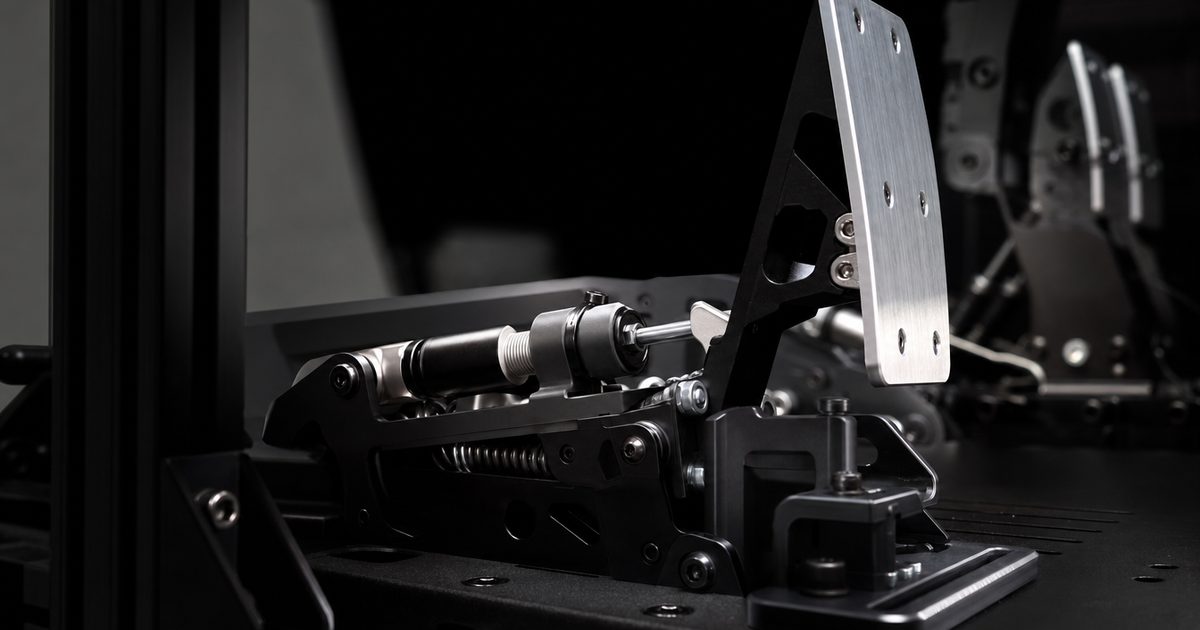
If I could go back and reorder my upgrades, I’d buy good pedals before I touched the wheelbase a second time. I spent a long stretch convinced my lap times were a wheel problem. They were a braking problem, and braking is a pedal problem. Here’s the honest story of the upgrade that did the most for my driving.
The pedals I started with
Most kits come with potentiometer pedals. A potentiometer measures position — how far down you’ve pushed the pedal. That sounds reasonable until you think about how real braking works. In a real car you don’t brake to a position; you brake to a pressure. You squeeze the pedal with a certain force, and the car responds to that force.
So with position-based pedals I was constantly looking at how far my foot had travelled instead of how hard I was pressing. Trail-braking — easing pressure off the brake as you turn in — was guesswork. I’d either lock up or leave time on the table, and I couldn’t tell you why on any given lap. The braking felt like an on/off switch with a vague middle.
What a load cell actually does
A load-cell pedal measures force, not distance. There’s a sensor that reads how hard you’re pressing, usually rated to some peak in kilograms of force. The pedal barely moves — you’re pushing against a firm stop, the way a real brake pedal pushes back against hydraulic pressure. Your braking input becomes about how hard your leg pushes, which is exactly how it works in a car.
The first night I ran load-cell pedals on my own rig, two things happened. First, my braking points got later and more consistent, because I was finally modulating by feel instead of by travel. Second — and this surprised me — trail-braking suddenly made sense. I could feel myself bleeding pressure off as I rotated the car into a corner, and the front tyres stayed alive instead of either locking or going light.
Why this beat my wheel upgrades
I’d treated braking as a wheel problem for ages. But the wheel tells you what the car is doing; the pedals are how you talk back to it. No amount of feedback fidelity through the rim fixes an input you can’t modulate. Once my brake input got precise, every other improvement I’d made through the wheelbase suddenly had something to work with.
The numbers backed it up. My braking consistency lap to lap tightened more from the pedal swap than from any single wheelbase change I made. The fast part of a lap is mostly about braking — where you brake, how hard, how you release it — and load-cell pedals are what gave me control over all three.
Setting them up: the one thing people miss
A load cell needs calibrating to your leg. Out of the box the force curve is often set for someone pressing much harder or softer than you. Spend ten minutes setting the maximum force to a pressure you can actually hit consistently and comfortably, then tune the curve so the middle of your braking range falls in the middle of the pedal’s range. Skip this and the pedals feel either impossibly stiff or hair-trigger twitchy, and people wrongly blame the hardware.
I run mine firm — closer to a real brake than most people expect — because once you adapt, the consistency is worth it. But there’s no single right answer; set it to your leg.
What I’d tell someone on the fence
If you’re running stock potentiometer pedals and wondering what to upgrade next, it’s the pedals. Not the rim, not another base. Two or three pedals is fine to start — a load-cell brake is the one that matters; the throttle being position-based is no problem at all.
I broke down the load-cell options, the 2-vs-3-pedal question and brake-force tuning in the best sim racing pedals guide. If you only make one upgrade this year and you want it to show up in your lap times, this is the one I’d make.