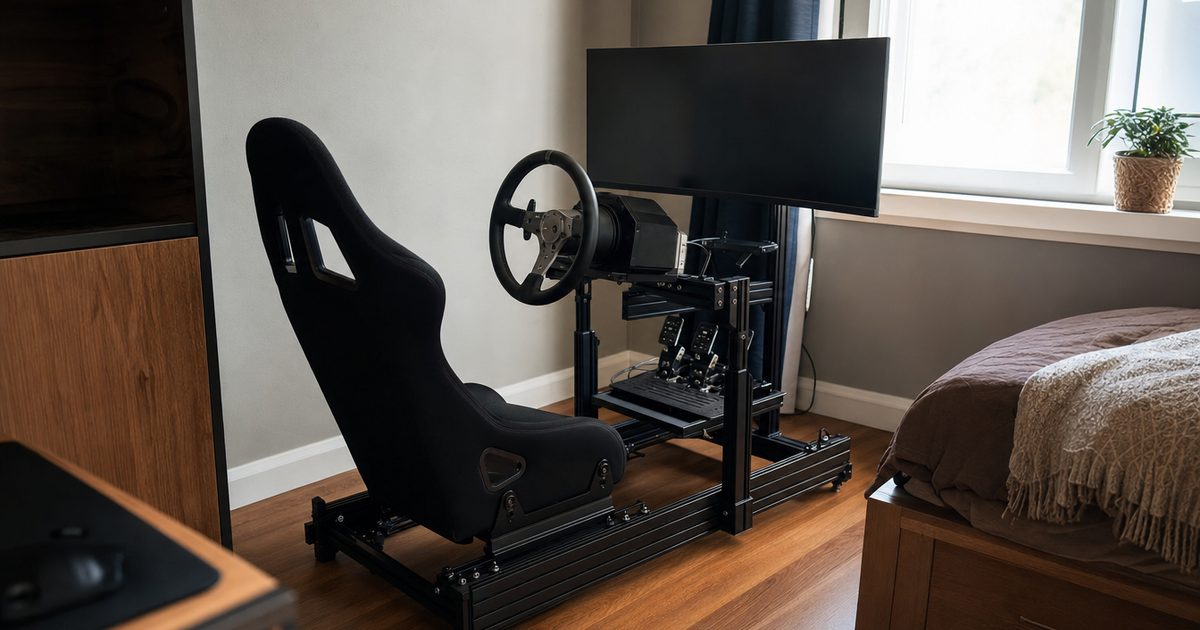
If I were starting over with a real-world budget, I’d build the rig in a very specific order — because the order is where most people waste money. I wasted mine by buying a cheap gear wheel first and re-buying later. Here’s the buying chain I’d actually follow now, what to spend on, and what to wait on.
The principle: buy in feel-order, not hype-order
Spend where you feel it most, in the order you feel it. The hardware between you and the car — the wheelbase and the pedals — is where your money does the most work. The stuff that holds it all together matters, but it’s a problem you can stage. Buy the things that change how the car feels first, then build the structure around them.
The order I’d buy in
1. The wheelbase — and start at the bottom of direct drive
This is the keystone, so it goes first, but “first” doesn’t mean “most expensive.” An entry direct-drive base in the 5–8 Nm range gives you clean, linear, non-clipping feedback — the thing that makes a car feel real. You do not need mid or high torque to be happy for years. What you must not do is buy a gear-driven wheel to save money now; that’s the exact mistake that nearly made me quit. Spend the wheelbase budget on the cheapest direct-drive base, not on a fancier gear one.
While you choose, also choose the ecosystem — the base commits you to a family of rims and pedals down the line, so pick the world you want to grow into.
2. The pedals — load-cell brake if you can stretch
Pedals are where the second-biggest gain hides, because braking is most of a fast lap. If the budget stretches, get a load-cell brake. It measures pressure, not travel, and it’ll do more for your consistency than almost anything else. A two-pedal load-cell set is a perfectly good start — you can add a clutch later. If load-cell genuinely isn’t affordable yet, this is the one place I’d say buy decent potentiometer pedals now and earmark load-cell as your first upgrade.
3. Something solid to mount it to — stand now, cockpit later
Here’s where you can stage. On day one, a genuinely sturdy desk or a solid wheel stand will hold an entry base fine. A flimsy desk, though, ruins more first nights than low torque does — so if your desk flexes, a rigid wheel stand is worth it before anything else structural. As your base grows past entry torque, graduate to an aluminium-profile cockpit. Don’t blow the launch budget on a top-end chassis before you’ve got the base and pedals sorted.
4. The rim
If your base came with a basic rim, run it. A nicer GT or formula rim is a real upgrade in ergonomics and buttons, but it’s a refinement, not a foundation. This is a “month three” purchase, not a launch-day one — and it’s an ecosystem decision, so it’s worth waiting until you know which rims fit your base cleanly.
5. Shifter, handbrake, extras
Discipline-specific and entirely optional at the start. A sequential shifter or handbrake matters if you’re into rally or older cars; for GT racing with paddle shift you may never need them. Add them when the racing you’re doing actually calls for them.
A realistic staged plan
For a real budget, I’d split it like this:
- Launch day: entry direct-drive base + decent pedals (load-cell brake if you can) + a solid stand or sturdy desk + whatever rim ships with the base.
- Month two or three: upgrade pedals to load-cell if you started on potentiometers, or add a nicer rim.
- Later: aluminium-profile cockpit once you’ve outgrown the desk or stand, then shifter/handbrake if your racing wants them.
This order means every dollar lands where you’ll feel it, nothing gets bought twice, and you never hit the “I bought the wrong type to save money” wall that cost me.
The one rule above all
Buy the right category once. The expensive mistakes in sim racing aren’t buying the mid base instead of the entry base — they’re buying the wrong type (gear instead of direct drive) or boxing yourself into the wrong ecosystem. Get those two right and even a modest budget builds into a rig you’ll love.
I broke down the entry direct-drive bases and which tier suits which budget in the best sim racing wheelbase guide. Start there, buy in this order, and you’ll skip the re-buying that taxes almost every beginner — including, once, me.