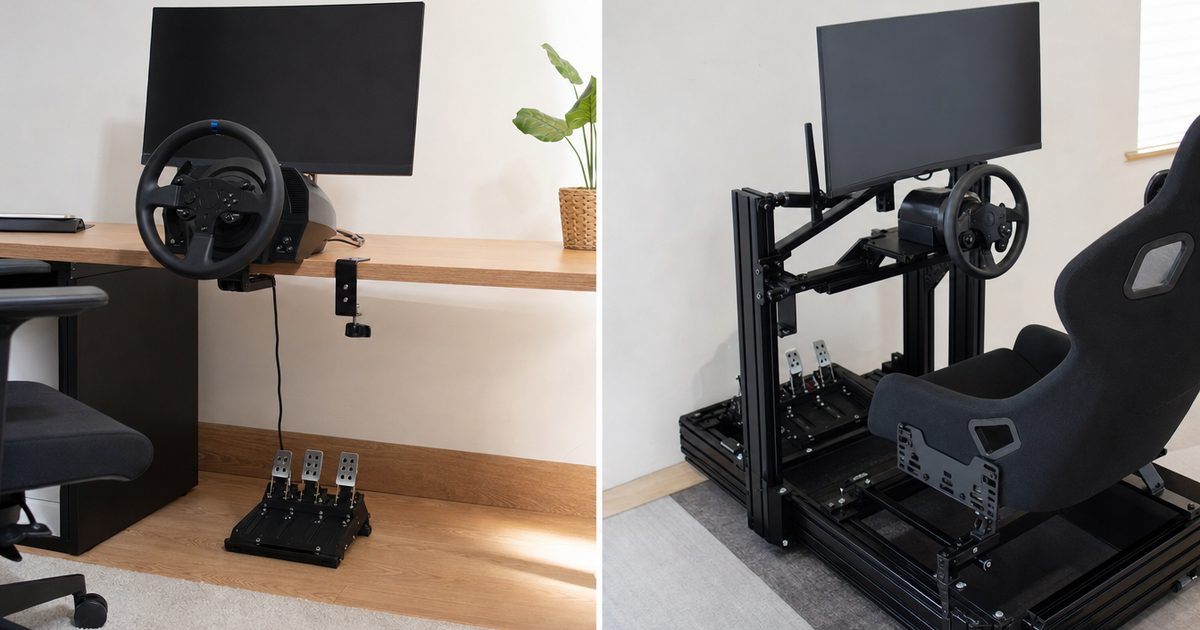
For a long time I told myself the desk clamp was fine. I had a direct-drive base, good pedals, the works — all bolted to a regular desk with a clamp. I figured a cockpit was a luxury, the thing you buy when you’ve run out of other things to spend money on. I was wrong, and a single league night is what finally convinced me.
How I ran the desk clamp
The setup was simple. The wheelbase clamped to the front edge of my desk. The pedals sat on the floor against a wall so they wouldn’t slide. My chair was a normal office chair. It worked, in the sense that I could drive, and for the first while I genuinely didn’t feel held back.
The problems crept in slowly enough that I blamed everything except the desk. Inconsistent braking? Must be my technique. The wheel feeling vague in fast corners? Maybe my force-feedback settings. A weird shudder under load? Probably the base.
The night it broke me
It came to a head on a league night during a long stint. We were doing a 40-minute race, and somewhere around the halfway mark I noticed the pedals had crept. The brake pedal had slid a couple of centimetres away from the wall, so my braking points were all subtly off and I couldn’t figure out why I kept missing apexes. Then in a hard braking zone the whole desk flexed — I could see the monitor shift — because the base was yanking the desk edge toward me every time the car loaded up.
I finished the race a mess. And it clicked: I wasn’t fighting the car, I was fighting the furniture. The desk was a moving reference point. Every input I made was relative to a platform that was itself shifting around. No wonder my braking was inconsistent — the pedals literally moved during the race.
What the cockpit fixed
I switched to an aluminium-profile cockpit. Not the most expensive one — a mid-range rigid chassis with the base, pedals and seat all bolted to the same frame. The difference was immediate and it fixed things I’d been blaming on completely unrelated gear:
- The pedals stopped moving. Bolted to the same frame as the seat, my braking reference never changed. Consistency went up overnight, and it had nothing to do with my technique.
- The desk-flex shudder vanished. With the base mounted to rigid extrusion, the force went into my hands instead of into a flexing desk edge. The car suddenly felt connected.
- My seating position became repeatable. Same seat, same distance, every session. On an office chair I’d been subtly resetting my whole body position every night.
The torque I already had finally arrived clean, because the rig could actually deliver it.
When to switch — my honest signals
A cockpit isn’t the first thing to buy. The base and pedals matter more for feel. But here’s when I’d say it’s time:
- Your base is mid-Nm or higher. Past entry torque, a desk clamp starts giving up. The more torque you run, the more a rigid rig matters.
- Your pedals creep or your desk flexes under braking. If you can see or feel the platform moving, your inputs are unreliable, full stop.
- You race long stints or league events. Consistency over 30-plus minutes is where a moving platform quietly wrecks you.
If you’re on a low-Nm base, light use, and short races, a sturdy wheel stand or a genuinely solid desk can hold you over. A flimsy desk ruins more first nights than low torque ever does — so if you stay on the desk, at least make it a heavy, stable one.
What I’d do differently
I’d have budgeted for the cockpit as part of the rig from the start, not as an afterthought. The order I’d buy in: base, pedals, then the rig that holds them properly. I covered the foldable-vs-profile-vs-stand decision and how to match a cockpit to your torque in the best sim racing cockpit guide. If your pedals are sliding or your desk is flexing, that league night is coming for you too — switch before it does.