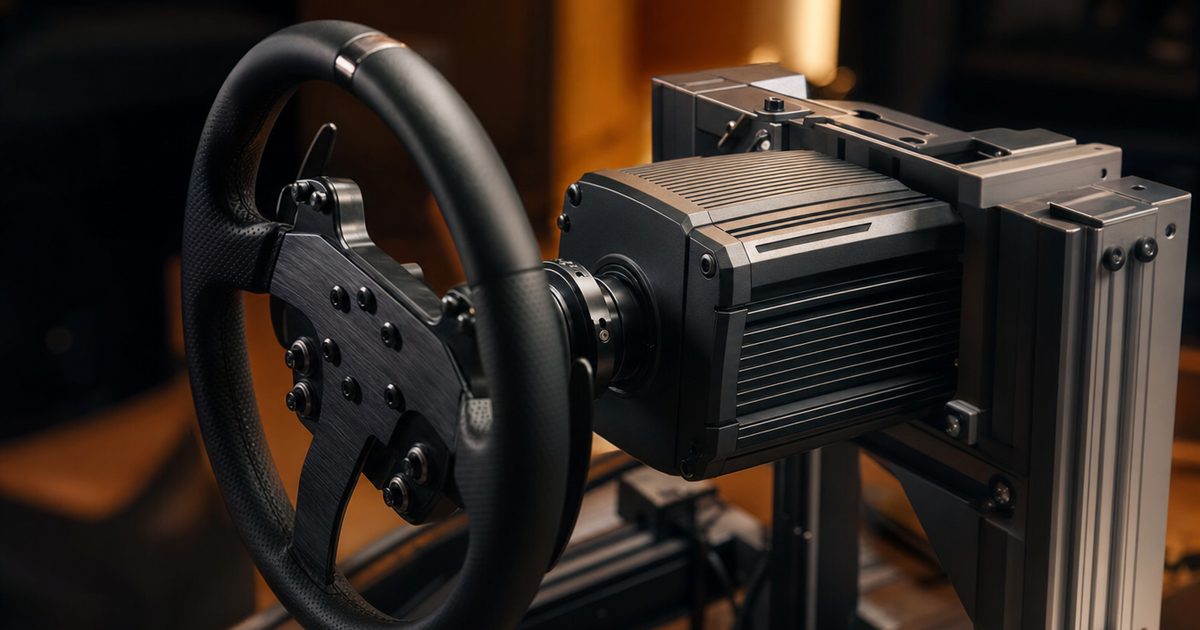
The most important decision when you buy a wheelbase isn’t the brand or the Nm number — it’s the drive type. Gear, belt, or direct drive. And it’s the decision people understand the least, because the spec sheet tells you the mechanism but not what it feels like from the seat. I’ve driven all three over six-plus years. Here’s the honest version.
Gear drive: where I started, and where I’d tell you not to
Gear-driven wheels use a system of gears between the motor and the wheel shaft. They’re cheap to make, which is why nearly every entry-level kit wheel uses them. They’re also where my own story nearly ended.
What gear drive feels like: notchy. You can feel the gears meshing as a kind of grainy texture under the smooth forces — a chattering that has nothing to do with the road. When the car loads up hard, gear wheels clip early, meaning the force maxes out and goes flat right when you need the most information. On-centre, around the straight-ahead position, there’s a vague dead spot. The overall impression is of a mechanism doing its best to imitate a car, and you can feel the mechanism the whole time.
For some casual driving it’s tolerable. As a way into the hobby, I think it does more harm than good — it’s what made me think sim racing wasn’t for me.
Belt drive: the middle ground that’s mostly fading
Belt-driven wheels replace the gears with belts and pulleys. The belts smooth out the notchiness — that grainy gear texture is gone, and belt wheels feel noticeably more refined and quieter than gear. For years, belt drive was the sensible mid-tier: smoother than gear, cheaper than direct drive.
What belt feels like: smoother than gear, but with a slight softness. The belts stretch a tiny amount under load, so very sharp, sudden forces — a kerb strike, a snap of oversteer — get rounded off a little. It’s a good feel. It was a genuine step up in its day.
The honest truth in 2026, though, is that belt drive is getting squeezed out. Entry direct-drive bases have come down in price to the point where they overlap with what belt wheels used to cost, and direct drive feels better. If you find a belt wheel at a real bargain, fine — but I wouldn’t seek one out new.
Direct drive: what finally made it feel real
Direct drive removes the gears and belts entirely. The motor connects straight to the wheel shaft. Whatever force the sim calculates is what arrives in your hands — no mechanism in between to add texture, soften edges, or clip early.
What direct drive feels like: clean and immediate. Forces build linearly, so as the front tyres load up in a corner you feel a smooth, progressive increase in weight, and as they let go you feel it ease — no flat-topping, no notch, no delay. Sharp events arrive sharp: a kerb is a crisp jolt, a snap of oversteer is a fast, clear lightening of the wheel. On-centre is precise instead of vague, so small corrections are small corrections. The first time I drove direct drive, the car stopped feeling like a simulation of a car and started feeling like a car.
So which should you buy?
My honest take after years on all three:
- Gear: Avoid for anything you care about. It’s the cheapest and it feels it, and it’s the most common reason beginners quit.
- Belt: A fine feel, but a fading category. Only worth it at a genuine bargain over an entry direct-drive base.
- Direct drive: Where to start, even at the bottom of the range. Entry direct drive gives you the clean, linear, non-clipping feel — and you can be happy there for years.
The drive type is the decision that sets the ceiling on everything else. Get it right and the torque number, the rim and the rest are refinements. Get it wrong and no amount of Nm saves it. I broke down the entry direct-drive options and where each tier makes sense in the best sim racing wheelbase guide. If you take one thing from this: buy direct drive, even the cheapest one, before you buy anything fancier of another type.